


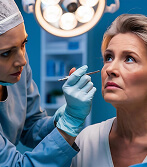

Skin Cancer of the Face and Neck: The Alliance of Oncological Rigor and High-Precision Aesthetics
When the health of your skin meets the art of facial reconstruction.
A suspicious skin lesion on the face, eyelids, nose, lips, or neck immediately raises two crucial questions:
- Will the tumor be completely and definitively removed?
- Will my face keep its harmony, expressiveness, and natural look?
As a specialist surgeon of the head, face, and neck, Dr Yousefpour provides a complete answer to both requirements. With advanced mastery of cervico-facial anatomy, every procedure is planned from the very first second as a dual act: eradicating the disease to the strictest oncological standards, and reconstructing the tissue according to the gold-standard principles of plastic and aesthetic surgery.
Our Areas of Expertise & Conditions Treated
Early diagnosis and careful analysis of the skin's architecture are essential:
- Basal cell carcinoma (BCC): The most common form of skin cancer, often caused by repeated sun exposure. Although slow-growing and rarely metastasizing to lymph nodes, its localized growth on the face (nose, ears, temples) requires millimeter-precise excision to preserve delicate structures.
- Squamous cell carcinoma (SCC): A more aggressive tumor that can infiltrate underlying tissue and spread to the neck's lymph nodes. It requires a rigorous excision strategy and careful lymph node monitoring.
- Cutaneous melanoma of the head and neck: Highly specialized surgical management respecting three-dimensional margins adapted to the Breslow index, with precise evaluation of the neck's lymph node chains.
- Precancerous lesions and rare tumors: Severe actinic keratoses, Bowen's disease, Merkel cell carcinoma, and dermatofibrosarcoma.
Unique Expertise: From Radical Treatment to Invisible Reconstruction
1. Oncological Excision with Controlled Margins
The absolute priority is your cure. Dr Yousefpour applies the strictest international protocols to remove the lesion with safe margins (both in surface area and depth), ensuring the maximum possible rate of local control.
2. Immediate Aesthetic Reconstruction: Preserving Your Identity
Removing a tumor should never disfigure. Thanks to his mastery of facial plastic surgery, Dr Yousefpour mobilizes neighboring tissue along precise anatomical planes:
- Local advancement, rotation, and transposition flaps: Custom redeployment of adjacent skin with the same texture, color, and thickness.
- Respecting the face's aesthetic units and sub-units: Incisions are hidden within natural folds, expression lines (Langer's lines), the eyelid contour, the nostril rim, or the hairline.
- Composite or full-thickness skin grafts: Harvested from discreet donor sites (behind the ear, above the collarbone) when tissue preservation requires it.
3. Neck Management & Lymph Node Dissection: The Definitive Treatment of Metastases
Unlike a purely dermatological or superficial cosmetic approach, Dr Yousefpour's cervico-facial surgical training allows him to manage the entire tumor pathway, including when it reaches the neck's lymph nodes:
- Selective or modified radical neck dissection: Removal of all lymph node groups that are affected or at high risk of metastasis.
- Functional neurovascular preservation: Millimeter-precise dissection protecting the facial nerve (marginal branch), the spinal accessory nerve (shoulder mobility), the vagus nerve, as well as the carotid artery and internal jugular vein.
The Patient Journey: Clarity, Safety, and Peace of Mind
- Consultation & clinical mapping: Dermoscopic analysis, 3D anatomical assessment of the lesion, diagnostic biopsy if needed, and an in-depth discussion of the reconstructive strategy.
- Personalized procedure: Performed under local anesthesia, conscious sedation, or general anesthesia, depending on the extent of the resection and whether neck surgery is required.
- Pathology validation: Systematic histological examination of the specimen to confirm the diagnosis and the complete absence of residual tumor at the excision margins (clear R0 margins).
- Post-operative scar care: Massage protocols, silicone dressings, sun protection, and rigorous periodic oncological follow-up.
Detailed FAQ
-
Will I be left with a visible scar on my face?Any skin incision leaves a biological mark, but the visibility of the scar depends entirely on the closure technique. Using advanced facial plastic surgery techniques, incisions are hidden within the face's shadows and natural folds (nasolabial folds, forehead lines, crow's feet, behind the ear). Tension is released in the deep tissue layers using invisible resorbable sutures, allowing for a fine, flat, discreet scar.
-
How does a cervico-facial surgeon's expertise make a difference for skin cancer?The head and neck contain a density of anatomy unique in the human body: motor nerves for facial expression, cartilage structures of the nose and ears, salivary ducts, and major blood vessels. A surgeon specialized in this region has the skill to safely excise the tumor without damaging these delicate structures, the artistic ability to reconstruct facial contours, and the surgical expertise to treat the neck's lymph nodes if the tumor has spread.
-
Why and when is a neck lymph node dissection performed?Some aggressive skin cancers (melanomas, extensive squamous cell carcinomas) tend to spread to the neck's lymph nodes. When these nodes are suspicious or confirmed to have metastasized, neck dissection is the only curative and definitive surgical treatment. It eradicates the regional disease before it can spread to the rest of the body.
-
What type of anesthesia is used for these procedures?Removal of a standard skin lesion and its immediate reconstruction with a local flap most often takes place under local anesthesia alone, or assisted by intravenous sedation, for optimal comfort as an outpatient. When a complex reconstruction with an extended flap or a neck lymph node dissection is needed, the procedure is performed under general anesthesia.
-
How long does it take to get the pathology results?The specimen is sent to pathology the same day. Full results confirming the nature of the lesion and the status of the excision margins are generally available within 7 to 10 business days, at your post-operative follow-up appointment.
Informed Consent & Medical Information Form
Facial Skin Oncological Surgery, Reconstructive Plastic Surgery & Neck Lymph Node Surgery
Practitioner: Dr Yousefpour — Maxillofacial, Plastic & Head and Neck Surgery
1. General Information About the Procedure
You are about to undergo a surgical procedure to treat a skin lesion in the head, face, or neck area. Dr Yousefpour has explained the indications, the oncological objectives, and your personalized reconstruction plan. Depending on your specific situation, the procedure includes:
- Complete oncological excision of the skin lesion, with an appropriate safety margin.
- Systematic pathology analysis at a specialized laboratory.
- Aesthetic and functional tissue reconstruction (direct suture, local advancement/rotation flap, or skin graft).
- If indicated: neck lymph node dissection, as a definitive surgical treatment in the event of regional spread or metastatic risk.
2. Potential Risks and Complications
Although performed with extreme technical rigor in a sterile, compliant surgical environment, every surgery carries a degree of risk:
General & scar-related complications:
- Bleeding, hematoma potentially requiring drainage, temporary facial bruising.
- Infection of the surgical site requiring local care or antibiotic therapy.
- Delayed healing, partial necrosis of the skin edge or flap (particularly increased by smoking).
- Unsightly, hypertrophic, or discolored scars (requiring extended care or a later touch-up).
Specific reconstructive and nerve-related complications:
- Reduced or temporarily lost skin sensation around the operated area.
- Temporary asymmetry or slight tension during facial movement while healing.
Complications specific to neck dissection (if lymph node surgery is performed):
- Risk of temporary (very rarely permanent) weakness or paralysis of the marginal branch of the facial nerve (asymmetric smile) or the spinal accessory nerve (difficulty raising the shoulder).
- Lymph fluid collection (lymphocele) or neck swelling that resolves over time.
Oncological risk:
- The need for a further procedure (re-excision of the margins) if the pathology examination shows the excision margins are microscopically insufficient (not clear).
3. Recommendations and Patient Commitments
To optimize the oncological and aesthetic outcome, you agree to:
- Report any anticoagulant or antiplatelet treatment, or drug allergies.
- Stop smoking completely for at least 2 to 4 weeks before and after the procedure, to prevent skin necrosis.
- Avoid all direct sun exposure on the scars for at least 12 months (applying SPF 50+ total sun protection).
- Attend all scheduled post-operative and oncological follow-up appointments.
4. Declaration and Signature
This consent form is reviewed and signed together with Dr Yousefpour in person prior to the procedure — it is presented here for your information so you can review it in advance.