




Excellence in Pre-Implant Bone Reconstruction
Restoring volume, securing your smile for life
Dr Yousefpour — Advanced Oral and Maxillofacial Surgery in Brussels and Waterloo
Redefining the Standards of Pre-Implant Bone Reconstruction
Placing a long-term, osseointegrated dental implant requires stable three-dimensional bone support, both in quantity and quality. When alveolar atrophy, long-standing tooth loss, or periodontal disease have compromised bone volume, simple and complex bone grafting techniques become the essential foundation for aesthetic and functional rehabilitation.
As a maxillofacial surgeon, my approach is built around rigorous digital planning and a highly predictable surgical technique. Whether preserving the extraction socket, augmenting the maxillary sinus, or reconstructing volume with autologous block grafts and tailor-made membranes, every procedure is designed to guarantee biological safety, minimize post-operative effects, and provide a lasting implant anchorage.
Philosophy: Expertise and Precision
Dr Yousefpour, an oral and maxillofacial surgeon in Brussels and Waterloo, offers excellence in the management of bone atrophy. Combining scientific rigor, digital planning, and state-of-the-art surgical technique, our mission is to durably restore lost anatomy to guarantee the success of your implant rehabilitation.
Ridge Preservation (Alveolar Preservation)
Maintaining bone capital after extraction. When a tooth extraction is unavoidable, natural bone resorption begins. To prevent this loss of volume, we systematically carry out ridge preservation.
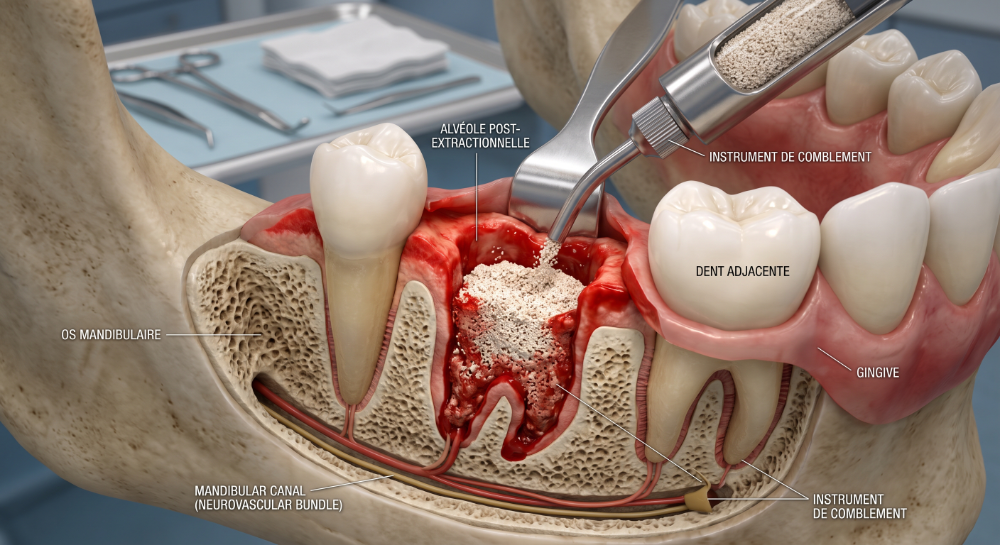
High-quality bone substitutes: Dr Yousefpour uses highly purified bone matrices of bovine or porcine origin, recognized for their biocompatibility, onto which your own bone tissue can regenerate.
- Bovine origin: Known for its stable mineral structure and slow resorption, ideal for maintaining a constant bone volume over the long term.
- Porcine origin: Characterized by more dynamic resorption, integrating well in sites requiring faster bone maturation.
Protective membrane barrier: In simple to moderately complex cases, the use of a protective membrane is essential. It plays two crucial roles:
- Cellular exclusion: It prevents epithelial cells (gum tissue), which multiply very quickly, from invading the graft site — giving bone cells time to colonize the substitute.
- Stability: It holds the bone powder particles in place, ensuring optimal architecture for your future implant. Depending on the case, we use resorbable collagen membranes (comfortable, no removal needed) or non-resorbable membranes in more complex contexts.
Advanced Surgery: Autologous Block Grafts and GBR
3D reconstruction: The art of advanced bone regeneration for major atrophies. When the residual volume is insufficient, we offer complex reconstruction protocols, favoring the gold standard: the autologous graft.
A. Autologous Block Grafts: The Excellence of "Custom-Made"
The autologous graft — using your own bone — remains the gold standard in maxillofacial surgery.
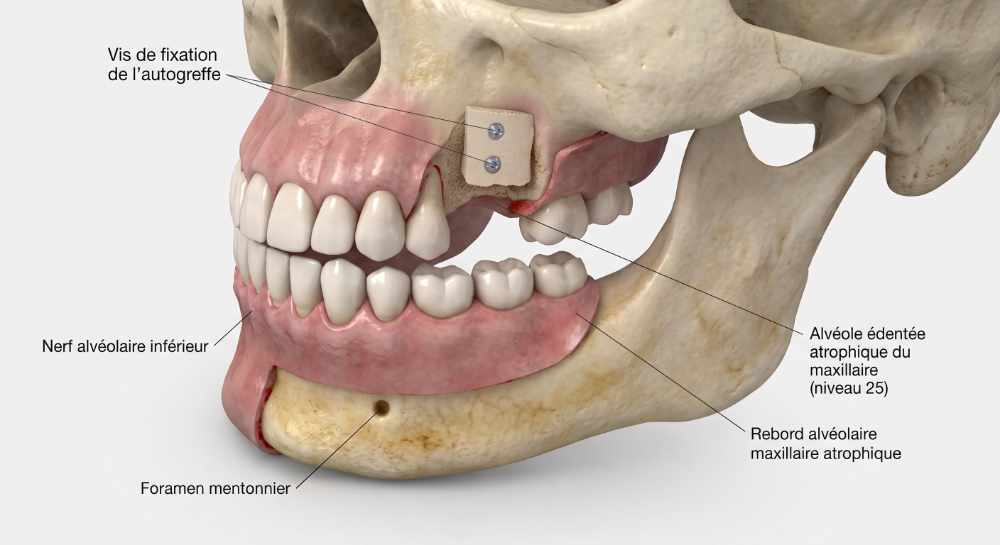
- The concept: We harvest a bone block from an intra-oral donor site (generally the mandible, at the chin or the ascending ramus). This block is then fixed onto the atrophied recipient site.
- Why an autologous block? Because it contains your own osteogenic cells and natural growth factors, it is the material best suited to complex healing. It allows reconstruction of significant vertical and horizontal defects where no other material would suffice.
B. Precision Through Guided Surgery (Mandibular Angle)
The major innovation in our practice lies in optimizing bone harvesting at the mandibular angle.
- Detailed analysis and 3D planning: From your CBCT imaging, Dr Yousefpour carries out a detailed analysis of your mandibular anatomy, with in-depth digital modeling, precisely locating the inferior alveolar nerve and other delicate structures to the millimeter.
- Custom surgical guides: This analysis allows specific harvesting guides to be designed and printed.

Why guided surgery? It transforms complex surgery into a highly standardized, safe, and predictable procedure. The custom guide secures every cutting trajectory, reduces operating time, minimizes post-operative effects, and guarantees the optimal quality of the harvested bone block.
C. 3D Guided Bone Regeneration (GBR)
For complex cases, Dr Yousefpour combines this expertise in autologous harvesting with digitally assisted GBR techniques.
- Precision meshing: Using titanium grids or reinforced membranes designed to create a protected "workspace." This volume is filled with a mixture of autologous bone (from the harvest) and a high-density mineral substitute.
- Digital planning: Using your CBCT, Dr Yousefpour virtually prepares the surgery. This scientific rigor allows him to predict how the graft will behave and to plan the placement of your future implants with millimeter precision.
Care Pathway: From Planning to Result
Surgical success is the result of rigorous planning:
- Diagnosis and 3D analysis: Detailed study of bone density and volume on CBCT.
- Digital simulation: Creation of your personalized surgical guides for optimal precision.
- Surgical excellence: A personalized procedure performed under advanced comfort protocols, under local anesthesia, sedation, or general anesthesia.
- Post-operative follow-up: Rigorous support for optimal healing.
My role as a surgeon is to turn a compromised bone site into fertile ground. These complex surgeries, although more demanding, are the guarantee of an implant stability that lasts a lifetime. Every decision — from the choice of graft to the suturing technique — is guided by a single objective: the long-term health of your smile.
— Dr. Afshin Yousefpour
Post-Operative Protocol: Bone Grafts & Pre-Implant Surgery
A dedicated section for patients, to ensure safe follow-up and optimal healing.
General Recommendations & Comfort
- Pain management: An appropriate prescription (pain relievers and, if necessary, anti-inflammatories or antibiotics) will be given to you at the end of the procedure. Please follow the dosages carefully.
- Swelling: Swelling is a normal reaction of the body after bone surgery. It generally peaks between 48 and 72 hours. Apply ice packs (wrapped in cloth, never directly on the skin) to the operated area intermittently (15 minutes on, 15 minutes off) during the first 48 hours.
- Bleeding: Light pink-tinged oozing is common in the first 24 hours. In the event of heavier bleeding, bite gently but firmly on a sterile gauze pad for 30 minutes.
- Infection prevention: Even with good brushing, bacteria are always present in your mouth and can cause infection — it is essential to take antibiotics regularly as prescribed to minimize this risk.
Oral Hygiene
- Brushing: Brush your teeth regularly but strictly avoid the operated area for the first few days so as not to disturb healing or strain the sutures.
- Mouthwash: Do not use any mouthwash on the day of the procedure. From the next day, gently use the prescribed antiseptic solution, without vigorous swishing.
- Strictly avoid: Spitting, sucking on the operated area, or touching the sutures with your tongue or fingers.
Diet & Lifestyle
- Diet: Follow a soft, cold (or lukewarm) diet for the first 4 to 5 days. Avoid hot, spicy, acidic foods, or foods with small grains (strawberries, sesame, etc.) that could lodge in the wound.
- Smoking: Tobacco is a major enemy of bone healing and significantly increases the risk of graft failure. Complete cessation, or a drastic reduction, is essential throughout the consolidation phase.
- Physical activity: Avoid any intense physical effort, heavy lifting, and sport for at least one to two weeks.
In case of emergency or an urgent question: Contact Dr Yousefpour at the number provided to you when you left the clinic.
Information & Informed Consent
Pre-Implant Surgery: Simple and Complex Bone Grafts
Practitioner: Dr. Afshin Yousefpour — Oral and Maxillofacial Surgeon
Dear Patient, you have insufficient bone volume in your jaw, which currently does not allow for the safe, long-term placement of dental implants. To address this, a bone reconstruction or augmentation procedure (simple or complex) has been proposed to you. In accordance with medical ethics and best practice, this document is intended to clearly inform you of the nature of the procedure, its benefits, how it is carried out, and its potential risks and complications.
1. Nature of the Procedure and Treatment Options
Depending on your clinical situation, the procedure may consist of:
- Ridge preservation or simple graft: Filling post-extraction sockets with purified bone substitutes (bovine or porcine) combined with a protective membrane (resorbable or not).
- Complex surgery with an autologous block graft: Harvesting your own bone (notably at the mandibular angle, optimized through digital planning and custom guided surgery) to correct major three-dimensional defects.
- 3D Guided Bone Regeneration (GBR): Use of reinforced grids or membranes to maintain the reconstruction space.
Therapeutic alternatives: Abstention (forgoing replacement of missing teeth), a dental bridge (which involves reshaping healthy teeth), or a removable prosthesis (a removable appliance, less comfortable) have also been explained to you.
2. Typical Post-Operative Course
All bone surgery causes normal physiological reactions:
- Swelling: Common in the cheek area, it peaks between 48 and 72 hours and subsides within about ten days. Applying ice and following the prescribed medication help limit it.
- Bruising: Skin or gum bruising may appear.
- Pain: Generally moderate, effectively controlled by the prescribed pain relievers.
- Temporary limitations: Temporary discomfort opening the mouth or slight blood-tinged oozing in the first 24 hours are possible.
3. Potential Risks and Complications
Despite all the rigor and expertise applied by Dr. Yousefpour, every surgical procedure carries inherent risk. The following complications, while rare in some cases, can occur:
- Infection of the surgical site or graft rejection: May require additional antibiotic treatment, or partial or total removal of the grafted material.
- Early exposure of the membrane or graft: Requires close monitoring and sometimes a change in the healing strategy.
- Sensory disturbances (paresthesia): Due to the proximity of anatomical structures (notably the inferior alveolar or mental nerve), numbness, tingling, or temporary (more rarely permanent) loss of sensation of the lip, chin, or teeth may occur.
- Sinusitis or oro-sinus communication: For procedures involving the upper jaw (sinus grafting).
- Partial or total graft failure: Which could compromise future implant placement and require a further reconstructive procedure.
4. Aggravating Factors and Patient Commitments
The success of the surgery also depends greatly on your cooperation:
- Smoking: Tobacco significantly impairs blood microcirculation and drastically increases the risk of graft failure and implant loss. Stopping, or a drastic reduction, is formally required.
- Hygiene and compliance: You agree to strictly follow post-operative instructions (appropriate diet, rigorous hygiene, not touching the area) and to attend all follow-up appointments.
- General health: You certify that you have given Dr. Yousefpour accurate and complete information about your medical history, allergies, and current medications (notably anticoagulants or bisphosphonates).
5. Expression of Informed Consent
This consent form is reviewed and signed together with Dr. Yousefpour in person prior to surgery — it is presented here for your information so you can review it in advance.